The blues is more than a genre. It is a voice born out of history, memory, hardship, and resilience. Though today we can point to songs, instruments, guitar riffs and stage performances, the true origin of the blues lies deep in human experience: in the lives of African-descended people in the American South who carried with them ancient rhythms, songs, and memories from Africa, and who found in music a way to endure suffering and express feelings that society around them refused to recognize.
As a musical form, the blues is often defined by certain characteristics: expressive use of blue notes (flattened thirds, fifths or sevenths), call-and-response patterns, and chord progressions such as the twelve-bar blues. But words and labels only scratch the surface. To truly understand the blues, one must trace its roots and the tangled history that allowed it to emerge.
From Africa to the Cotton Fields: Musical Roots and Slavery’s Legacy
The ancestors of the blues arrived in North America not merely as bodies, but as carriers of a rich musical tradition. The rhythms, vocal inflections, spectral melodies and social functions of music, for work, for spiritual comfort, for communal solidarity, came from West Africa.
In the plantations of the American South, enslaved Africans and their descendants used songs to endure brutal labor: work songs, field hollers, chants, and spirituals. These musical forms reflected African traditions but adapted to the context of forced labor, dehumanization, and displacement.
Spirituals, religious songs born from the conversion of Africans under slavery, played a central role. In them, one can find early building blocks of what would become the blues: repetition, vocal expression of longing, pain, hope; the interplay between collective voice and individual lament. But after the abolition of slavery, the context changed, and with it, the nature of these songs.
Emancipation, Sharecropping, and the Rise of the Blues
With the end of the Civil War and the formal abolition of slavery in the United States, African Americans entered a new and perilous phase. Freedom was granted, but economic oppression, sharecropping, racial segregation and social isolation remained. In this painful transition, music became a container for new experiences: loss, uncertainty, longing for dignity, memory of the past, and hope for the future.
It was in this era that the blues began to take shape. Rather than the communal songs of plantation life, the blues emerged as a more personal, often mournful expression. It was music of freed people, but people still oppressed people tied to the land, working in cotton fields or sharecropping for meagre wages.
The Mississippi Delta region is frequently cited as the birthplace of early blues. There, African-American communities were densely concentrated, and cotton agriculture was dominant. It was fertile ground, literally and culturally, for the blues to grow.
In those conditions, music served as solace, as confession, as mourning, but also as resistance. The bluesman became a figure: poet, musician, witness of suffering, transmitter of memories. In some sense, he assumed a role long familiar to African traditions: storyteller, mediator of emotions, keeper of communal memories.
Folk, Gospel and Early Popular Music
The blues did not arise in a vacuum. Its musical DNA draws from multiple sources: African rhythms and modes, spirituals, work songs, and also from European-American folk traditions. Over time, as Black and white musical cultures collided and mingled in the South, the blues absorbed elements from minstrel shows, medicine shows, jug bands, and other early popular entertainment formats.
At the turn of the 20th century, developments in transportation and early recording technology began to accelerate the diffusion of these musical forms. What had once been informal field hollers or tent-show songs gradually could reach audiences farther away, planting the seeds for modern commercial blues.
Still, because the blues emerged in largely oral, marginalized communities, its earliest stages left few written documents. As a result, the exact moment of the blues’s birth is impossible to pinpoint. Instead, scholars speak of a gradual coalescence of musical and social conditions.
From Porch to Stage
By the early 1900s, the blues began to step out of fields and informal gatherings, entering performance circuits such as tent shows, traveling minstrel troupes, vaudeville, small towns and juke joints. Among the first to bring blues music to a broader, more public stage were artists like Ma Rainey, often cited as the “Mother of the Blues.”
Another pivotal figure is W. C. Handy, sometimes called the “Father of the Blues.” Though he did not invent the blues, his role in popularizing it was decisive. According to his own account, Handy first heard a blues-like song in 1903 while waiting at a train station in Tutwiler, Mississippi: a man playing guitar with a knife on the strings, producing sliding, mournful notes. That experience stayed with him.
In 1912 Handy published “Memphis Blues,” one of the first blues compositions to be distributed as sheet music. Soon dance bands across America began playing it. A few years later, “St. Louis Blues” further cemented blues as a mainstream phenomenon.
With these songs on paper, the blues stepped into a new era: no longer just folk expression, but something that could be studied, reproduced, adapted, and transformed across distances in recordings, on stages, in theaters.
More Than Music
More than a style, the blues was a language, a language born from pain, injustice, longing, resilience. For Black Americans in the decades after emancipation, the blues offered a rare space for emotional truth: sorrow, love, betrayal, injustice, hope. It was a way of confronting hardship, of standing witness to suffering, of asserting identity.
In that sense, the blues had a communal, even therapeutic dimension. Musicians who sang the blues often carried the memory of slavery, the brutality of sharecropping, the humiliation of segregation, but also the strength to endure and to acknowledge pain. The bluesman took on a role akin to that of a seer or a community poet, someone who transforms individual sorrow into something collective, universal.
Blues was also a bridge. A bridge between Africa and America, between the past and the future, between African-derived traditions and European-American folk, between silence forced by oppression and expression demanded by humanity.
Spreading the Blues Beyond the Delta
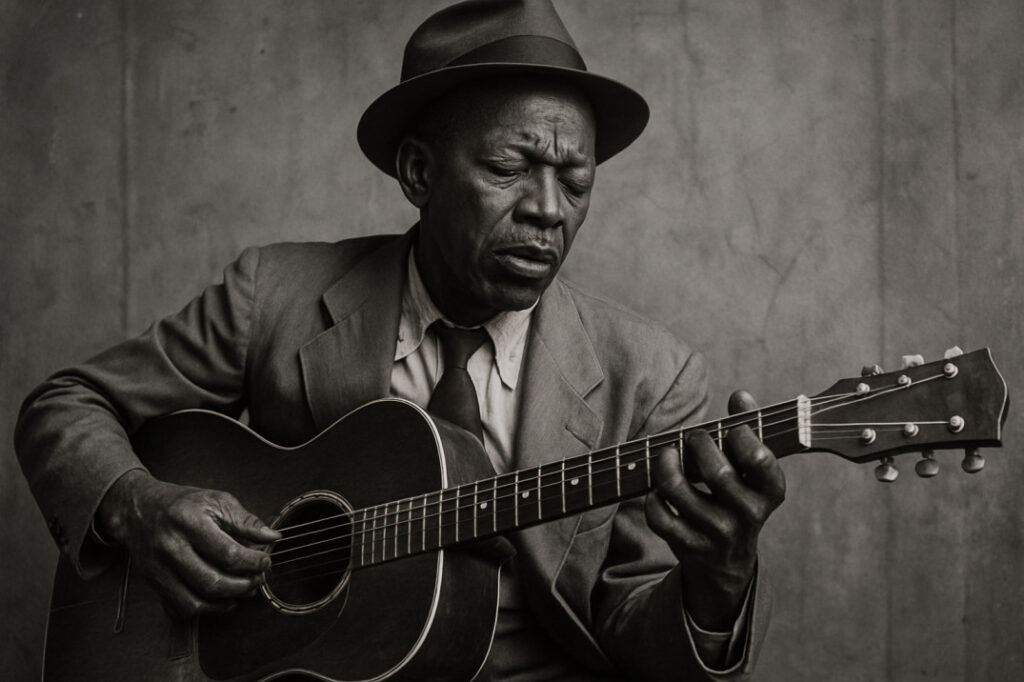
As the 20th century progressed, the blues did not remain confined to rural Mississippi or the South. Sociopolitical changes prompted waves of displacement and migration: African Americans moved northwards, seeking better opportunities and escaping racial violence. Along with people, music traveled.
Cities like Memphis, St. Louis, Chicago, Detroit and others became hubs for new forms of blues ,electric blues, urban blues, stepping away from the acoustic tradition of the Delta, adding guitars, harmonicas, drums, and embracing the technology of amplification.
This transformation was more than technical. It reflected changing lives: the transition from agricultural labor to urban and industrial work, from rural isolation to complex urban communities, from anonymity to new forms of visibility and performance. The blues adapted, migrated, evolved, but preserved its essence: emotional honesty, musical directness, expressive power.
Legacy and Influence
The impact of the blues has been profound and enduring. Within American music, it became a foundational pillar, not only for blues itself, but for genres that followed: jazz, rhythm and blues, rock and roll, soul, even country in some regions.
The patterns of blues, its chord progressions, its call and response, its expressive bends and blue notes seeped into modern popular music. The emotional depth, the honesty, the rawness, became a language adopted by musicians far beyond the Mississippi Delta.
Moreover, the blues stands as a cultural testament: to suffering and resilience, to memory, to a people’s capacity to transform pain into art, to create beauty under oppression. That legacy still resonates today in festivals, recordings, reinterpretations around the world. The blues is not just entertainment. It is history, lived and told.
Challenges in Tracing Origins
One of the complexities in writing about the blues is that there is no definitive founding date or single first blues song. Because its roots lie in oral traditions, slave songs, field hollers and informal communal music, little was written down or recorded in the early decades.
Scholars often speak in terms of convergence: Africa’s musical heritage meets American hardship; rural communal song evolves into personal expression; social upheaval meets technological innovation. The shift from work songs to blues ballads, from plantation gatherings to juke joints and minstrel shows, all of these transitions contributed bit by bit.
Thus, the blues is less a sudden invention than a gradually crystallizing form: part memory, part improvisation, part adaptation, a living tradition that emerged out of necessity, pain, creativity, and survival.
The Soul of the Blues
The blues is nothing less than a human chronicle, a chronicle rooted in the suffering, resilience, hopes, tragedies, and small joys of people who had no other means of preserving their voice except through song. It speaks to pain and injustice, but also to dignity, endurance, and creativity.
From the shores of West Africa, through the cotton fields of the Mississippi Delta, from sharecropping shacks to urban clubs, from solitary guitars to amplified bands, the blues has evolved yet kept its essence: honesty, longing, melody born from memory.
When we listen to a blues song, a slide-guitar moan, a trembling vocal, a mournful harmonica, we are hearing far more than music. We are hearing history. The blues remains as relevant now as ever, not only as art, but as testimony: a reminder of where we came from, what was endured, and what beauty arises when humans insist on expressing their truth.