BSBE Music Theory

Teaching you every day

This content shows Simple View

Blogging

Development gaps in Music Learning Across Countries

Music learning changes from country to country because it depends on much more than talent. It depends on curriculum design, public funding, teacher preparation, family income, local culture, school infrastructure and the political value assigned to the arts. A child in Germany, Japan, Finland, Brazil, Nigeria or India may study rhythm, melody, harmony, timbre and musical form, but the route to those concepts is not the same. In one system, music is delivered through public schools, specialist teachers, graded assessment, youth ensembles and conservatories. In another, music is learned through family practice, religious groups, local festivals, oral repetition and community performance. Both routes can produce strong musicianship. The difference is the stability of the system that turns musical exposure into continuous instruction.
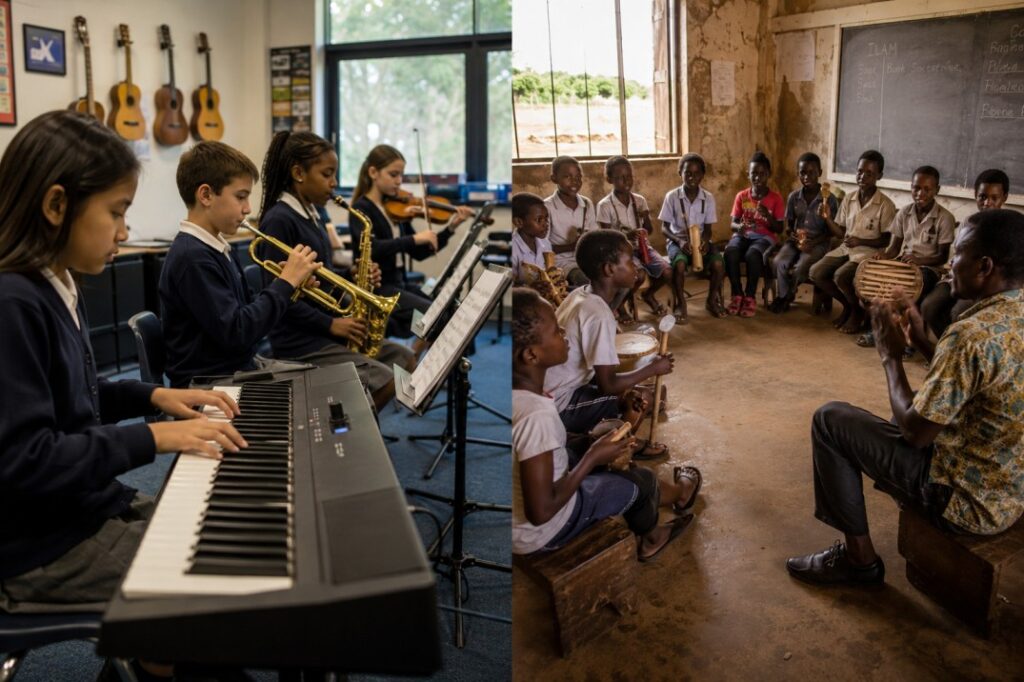
different opportunities in different countries

In this article, the term underdeveloped is used in a strictly educational and economic sense. It refers to contexts where weak public finance, low school completion, limited infrastructure and shortages of qualified teachers restrict the delivery of formal education. It is not a judgment about cultural value. Many underdeveloped countries have extremely rich musical traditions, complex rhythmic systems, strong vocal practices and deep community based musical knowledge. The problem is not lack of music. The problem is the limited capacity of formal institutions to teach music regularly, technically and equitably.

In developed countries, music education usually has a clearer institutional structure. Primary schools tend to introduce singing, listening, movement, rhythm, basic notation and ensemble participation. At secondary level, music often becomes more specialized. Students may choose composition, performance, music technology, theory, history or ensemble work. Outside school, many high income countries have conservatories, municipal music schools, private studios, youth orchestras, choirs, jazz programs and digital production labs. These structures create continuity. A student can begin with classroom singing, move into instrumental study, join an ensemble, prepare auditions and later enter professional or academic pathways. For example, in Brazil they would go to youtube and search for “curso de violão” (as it is said in portuguese) to start their learning journey. Or they will go for private lessons.

The main technical advantage in developed systems is not only money. It is predictability. Schools can plan timetables, hire trained music teachers, maintain instruments, use rehearsal rooms and assess progress over several years. Students are exposed to musical literacy, ear training, performance discipline and collaborative practice in a sequence. In countries such as Finland, Germany, Japan, South Korea, Canada and parts of the United States, music is often connected to broader educational goals such as creativity, attention, memory, cultural knowledge and social development. The curriculum may differ, but the presence of organized pathways gives students a higher probability of sustained learning.

Still, developed country status does not eliminate inequality. In the United States, England, Australia and other wealthy systems, access can vary sharply by district, household income and school type. A school in an affluent area may have bands, choirs, recording equipment, private lesson networks and performance spaces. A school in a poorer area may have one generalist teacher, limited instruments and few extracurricular options. Families with higher income can pay for private lessons, instrument rental, exam fees, transportation and digital equipment. As a result, the inequality in developed countries is often a problem of intensity and specialization rather than complete absence. Music exists in the system, but not every student receives the same depth of training.

Underdeveloped countries show a different pattern. In many cases, music is culturally present but institutionally fragile. A child may grow up surrounded by sophisticated drumming, singing, dance, ritual music or popular music, yet attend a school with no music room, no tuned instruments, no full time music teacher and no stable arts timetable. In rural areas, the problem can include electricity, internet access, transport and basic classroom conditions. In urban areas, the issue may be overcrowding, exam pressure and lack of trained staff. Music education may appear in curriculum documents, but implementation depends on local capacity.

This creates a technical gap between cultural knowledge and formal instruction. Community music often teaches timing, memory, participation, improvisation and identity very effectively. However, students may not receive systematic training in notation, harmony, composition, acoustics, digital production or instrumental technique. Formal music education can expand those skills, but only when schools have teachers, materials and time. Without those conditions, music remains present in society but unevenly translated into educational opportunity.

Teacher supply is one of the central differences between developed and underdeveloped systems. Music teaching requires more than general classroom management. A good music teacher needs practical musicianship, knowledge of child development, repertoire selection, ensemble direction, listening pedagogy, assessment methods and cultural sensitivity. Developed countries usually have universities, conservatories or teacher training colleges that prepare music specialists. Underdeveloped countries often have fewer training programs, lower teacher salaries and more competition for limited education budgets. When a system lacks enough teachers for literacy, numeracy and science, specialized arts teachers are often treated as optional.

The cost of materials also matters. Music is not the most expensive subject in every form, since singing, body percussion and local instruments can be low cost. However, many forms of school music require durable resources. Keyboards, guitars, drums, wind instruments, strings, microphones, speakers, computers, notation software and rehearsal spaces need investment and maintenance. In developed countries, these costs may be absorbed by school budgets, parent associations or cultural programs. In underdeveloped countries, the same costs can block participation. A single broken keyboard or missing drum set can remove an entire class of activities from the timetable.

Digital technology has changed the picture, but it has not removed inequality. In developed countries, students may use recording software, virtual instruments, online tutorials, notation platforms and remote collaboration tools. These tools make composition and production more accessible and connect school music to contemporary genres. In underdeveloped countries, mobile phones can also open important learning opportunities, especially through video lessons and local content sharing. Yet digital learning depends on electricity, internet stability, devices, language access and teacher guidance. Without those conditions, technology can widen the gap between students who can practice at home and students who cannot.

A strong policy approach should not copy one country blindly. Developed countries can improve by reducing the dependence on private lessons and by protecting music in public schools, especially in low income areas. Underdeveloped countries can improve by combining formal instruction with local musical traditions instead of replacing them with imported models. A realistic program may begin with voice, percussion, movement, local repertoire and community musicians, then expand gradually into notation, ensemble work, instrument libraries and digital production. The goal is not to make every country teach the same music. The goal is to give every student a serious path into musical understanding.

Music learning is therefore both an artistic issue and an infrastructure issue. Developed countries usually have stronger systems for continuity, specialization and progression, but they still struggle with social inequality. Underdeveloped countries often have powerful musical cultures, but weaker formal mechanisms for turning that culture into regular school instruction. The most effective model is not the richest or the most standardized one. It is the model that connects culture, trained teachers, public investment and long term access. When those elements work together, music becomes more than an extracurricular activity. It becomes a disciplined form of knowledge, a social practice and a technical language through which students learn to listen, coordinate, create and participate in their own culture with greater depth.


When 0 dBFS is not really the top

There is a funny little trap in modern music production: you can stare at a digital peak meter all day, see it politely stopping at 0 dBFS, and still end up with distortion after export. Not distortion you chose, not the kind that makes a snare feel aggressive or a bass feel wider. I mean the annoying kind that shows up only when the file is converted, streamed, or played back on a different device.

This is where True Peak quietly becomes one of those topics that separates a mix that merely sounds good in your session from a master that behaves well in the real world.

A lot of us learned gain staging with a simple mental model: digital audio has a ceiling, and that ceiling is 0 dBFS. Stay under it, and you are safe. Push into it, and you clip. That story is not exactly wrong, it is just incomplete. Digital audio is made of samples, but playback is a continuous waveform. Somewhere between the samples, the waveform can rise higher than the sample values suggest, especially once you run it through reconstruction filters, conversion stages, or lossy encoding. Those between sample moments are called intersample peaks, and they are the reason True Peak meters exist.

The first time you really notice it, it feels unfair. You will have a master peaking at, say, -0.2 dBFS, everything looks fine, and then the encoded version starts making a cymbal edge sound crunchy. You lower the limiter, export again, and the crunch is still there. That is the moment most people finally ask the right question: what exactly is my meter measuring.

The difference between a snapshot and the movie

A sample peak meter measures the highest sample value. It is like checking the tallest pixel in a photo. A True Peak meter tries to estimate the highest point of the reconstructed waveform, closer to what actually hits speakers and ears after conversion.

Think of a sine wave sampled at a low rate. Even if no single sample lands exactly on the sine wave crest, the crest still exists between samples. Increase the sample rate and you get a better picture, but at common production rates you are still dealing with a representation, not the continuous reality. The True Peak idea is basically this: if we upsample the signal internally, we can predict those between sample crests more accurately, then report a peak value that behaves like the real waveform peak.

This is why you will see True Peak meters described as using oversampling. It is not oversampling for tone, like a distortion plug in sounding smoother. It is oversampling for measurement, for honesty.

And once you accept that honesty, a few confusing studio moments suddenly make sense.

You know that chorus that sounds clean inside the DAW, but the moment you export to AAC it gets spitty? The high frequency content plus limiting can produce very steep waveforms. Lossy encoders and reconstruction filters can create overs that were not visible as sample peaks. A True Peak meter tends to catch those earlier, and a True Peak limiter can prevent them from happening in the first place.

This is one of the most practical reasons True Peak matters for music, not just broadcast.

Loudness normalization changed the game, but it did not remove the need for craft

The streaming era introduced loudness normalization, and with it, a lot of myth making. People say things like everyone is mastered to the same loudness now, so dynamics are back. Or the loudness war is over. Or LUFS is all that matters.

Real life is messier, and more interesting.

Normalization means platforms turn tracks up or down to hit a target loudness. Loudness here is usually measured in LUFS, based on standards that try to model perceived loudness rather than raw peaks. That is good. It makes playlists more pleasant, it reduces the incentive to slam everything into a limiter, and it gives quiet records a chance to sit next to loud ones without the listener constantly reaching for the volume control.

Still, normalization does not protect you from everything. A track that is heavily limited can end up turned down, yet still feel smaller, flatter, and more fatiguing than a more dynamic master at the same normalized loudness. At the same time, a track that is too dynamic can feel underpowered in a noisy environment even if it is normalized to the same integrated LUFS. Streaming did not delete the role of mastering. It just changed the incentives.

True Peak lives inside this shift in a very particular way.

Normalization is about average loudness over time. True Peak is about the maximum instantaneous ceiling. They are related, but they solve different problems. You can have a master with a healthy integrated LUFS and still have True Peak overs. You can also have a master with conservative True Peak and still have a loudness that gets turned down. The craft is in balancing both in a way that serves the music and survives real world encoding.

Why True Peak limits are usually negative numbers

If you ever wondered why so many recommendations say keep True Peak below -1 dBTP, the reason is not superstition. It is about headroom for downstream processing.

A platform might transcode your file into multiple codecs at multiple bitrates. A user might enable EQ, volume leveling, or other playback processing. Their phone might apply its own limiter to protect tiny speakers. Every one of these stages can shift peaks upward, especially if the waveform is already pushed right to the edge.

Leaving some True Peak headroom is like leaving room in a suitcase before you start stuffing souvenirs into it. The suitcase might close if you pack it perfectly at home, but the moment you add anything else, the zipper fights back.

A very common practical ceiling is -1 dBTP for general safety, with some engineers going a bit lower for very dense material or for certain codecs. The exact number is not magic, but the principle is consistent: if you deliver a master that never exceeds a conservative True Peak ceiling, you dramatically reduce the odds of ugly surprises after conversion.

You can also feel this in a more musical way. When you stop chasing the last fraction of a decibel, you often regain a sense of ease in the transients. The kick breathes. The snare has a little more snap without that brittle rim. The vocal sibilants stop feeling like they are fighting the limiter.

A quick detour into LUFS that actually helps

It is hard to talk about True Peak in 2026 without talking about LUFS, because most people meet True Peak through loudness meters.

Integrated LUFS is the average perceived loudness of the whole track. Short term LUFS looks at a shorter window, often a few seconds. Momentary LUFS looks at an even smaller slice. These measures are valuable because they correlate better with what listeners experience than peak meters ever did.

But here is the thing that trips people up: you can hit a target integrated LUFS with very different internal shapes.

One master might have gentle compression, some transient life, and a limiter barely kissing the peaks. Another master might have heavy compression, clipping, and a limiter doing constant work. Both can land at the same integrated LUFS, especially once normalization turns them down to match. Yet they feel completely different. The second one often feels smaller and more tiring, even though it is not louder anymore.

True Peak is not the cure for that, but it becomes part of a healthier workflow. When you manage True Peak properly, you are less tempted to pin the limiter at zero and more likely to make loudness decisions with tone and groove in mind.

The streaming chain is not your mastering chain

One of the best mindsets you can adopt is to treat streaming as a second mastering stage you do not control.

Your file is delivered. Then it gets decoded, possibly normalized, possibly transcoded, then played back through unknown processing. That means your job is not only to make the master sound good, but to make it robust.

True Peak headroom is robustness.

So is avoiding extreme limiting that creates razor sharp waveforms. So is checking how your master behaves when turned down, because normalization might do exactly that. A master that only sounds exciting when it is loud, and collapses when reduced by 4 dB, is a fragile master.

A robust master still feels punchy when the volume changes, still feels balanced when encoded, still feels like itself when the listener is in a car with road noise or on earbuds on the subway.

In practice, robustness often looks like slightly more conservative peak management, slightly more attention to midrange balance, and slightly less obsession with hitting some internet approved LUFS number.

True Peak meters are not all the same

This part is subtle, and it matters.

A True Peak meter estimates intersample peaks through oversampling, but different tools can oversample at different rates and use different reconstruction filters. One meter might show -1.0 dBTP while another shows -0.7 dBTP for the same file. That can feel maddening until you remember that you are measuring an estimate of an analog reality. The estimate depends on the model.

So what do you do.

You pick a reliable meter that is known to follow the relevant standards, you learn its behavior, and you build a small buffer so you are not living at the edge. If your target is -1 dBTP, aiming for -1.2 or -1.3 on your tool gives you peace. It also makes your decisions less twitchy. You stop chasing the meter and you start listening again.

The human part of mastering is deciding what you want the limiter to do

A True Peak limiter is not just a safety device. It is also a sound. Some True Peak limiters are clean and boring, which is sometimes exactly what you want. Some add a little density. Some soften transients. Some smear stereo image if pushed too hard. None of that is a moral issue. It is just audio.

What changes when you work with True Peak intentionally is that your limiter is no longer your last second panic button. It becomes part of the tone shaping, and the True Peak ceiling becomes a boundary you respect.

If you have ever done that thing where you push the limiter threshold down, the track gets louder, the snare loses its crack, so you add a transient shaper, then the hi hats get sharp, so you add a de esser, then the mix feels thin, so you add low mids, then you push the limiter again, and suddenly you are three hours deep and annoyed at yourself, you already know how easy it is to let the limiter become the whole project.

True Peak discipline interrupts that loop. It nudges you back toward upstream choices: arrangement, balances, compression that breathes, saturation that is musical, clipping that is deliberate, and limiting that is not carrying the entire emotional weight of the record.

What actually causes those post export overs

Let us put some concrete causes on the table, because this is where the topic stops being abstract.

A master with aggressive limiting often produces flat topped waveforms and fast edges. These edges contain high frequency components. When you reconstruct the waveform, those components can overshoot between samples. If you then encode to a lossy format, the codec can introduce slight changes that push the reconstructed peaks higher still. Then a playback DAC reconstructs again with its own filter, and now you have a little overshoot that turns into clipping in a device that has no headroom above full scale.

Sometimes the clipping is tiny, just a few samples. On a sustained synth you might never notice. On a bright vocal consonant or a sharp snare, you might hear a brittle click. The reason it is so frustrating is that it can appear only on some systems, or only in the encoded version.

True Peak limiting reduces the odds because it tries to guarantee that even the reconstructed waveform stays under your chosen ceiling.

How to work in a way that stays fun

At this point, the technical picture is clear enough. The bigger question is how to apply it without turning your process into a checklist.

One approach that works surprisingly well is to separate creative loudness from delivery safety.

Do your creative decisions first. Make the master feel right. If the track is supposed to feel intimate, let it breathe. If it is a club record, let it hit. Get the tonal balance, the punch, the emotional arc. Then, once you are satisfied, you look at loudness and True Peak as delivery constraints, like file format and sample rate. You make small adjustments to meet them, rather than sculpting the whole sound around them.

If you do it in the opposite order, you often end up with a master that is technically compliant and emotionally dull. You can feel it. The music stops winking at you.

There is also a simple listening trick that reveals whether your loudness decisions are musical or just numerical: turn the master down by several dB and see if it still feels exciting. If it collapses, it probably relied too much on level rather than contrast. If it still feels alive, you have done the harder, more satisfying work.

The quiet advantage of leaving space

It is worth saying out loud: leaving headroom can make your music sound more expensive.

Not because loud music is bad. Loud music can be thrilling. The point is that clean loudness tends to come from controlled density, not from pinning peaks to the ceiling. When you leave a little True Peak space, you often also leave room for transient shape, stereo clarity, and low end movement. The mix feels less stressed.

Listeners may never know what dBTP means, but they recognize the feeling of a track that is not fighting itself. The chorus opens instead of flattening. The vocal stays present without being harsh. The cymbals sparkle without sandpaper. Those are human responses to technical choices.

And the best part is that this approach travels well. It survives playlist normalization. It survives codec conversion. It survives a phone speaker trying its best.

A closing thought you can carry into the next session

True Peak is one of those topics that looks like pure engineering until you realize it is really about trust.

You are telling the listener: this record will sound good wherever you meet it. On streaming, on earbuds, on a Bluetooth speaker, on a car system, on a friend phone with unknown settings. You are not handing off a fragile object that only behaves inside your DAW.

So yes, measure True Peak. Use a reliable True Peak limiter. Leave a little headroom. But do it with a calm attitude. The goal is not to become a compliance robot. The goal is to protect the musical choices you already made, so they arrive intact on the other side of the internet.

Once you work that way for a while, you will notice something slightly ironic. You will spend less time thinking about loudness and meters, and more time listening. The technical part becomes a quiet layer underneath the art, where it belongs.


The birth of a voice, the blues

The blues is more than a genre. It is a voice born out of history, memory, hardship, and resilience. Though today we can point to songs, instruments, guitar riffs and stage performances, the true origin of the blues lies deep in human experience: in the lives of African-descended people in the American South who carried with them ancient rhythms, songs, and memories from Africa, and who found in music a way to endure suffering and express feelings that society around them refused to recognize.

As a musical form, the blues is often defined by certain characteristics: expressive use of blue notes (flattened thirds, fifths or sevenths), call-and-response patterns, and chord progressions such as the twelve-bar blues. But words and labels only scratch the surface. To truly understand the blues, one must trace its roots and the tangled history that allowed it to emerge.

From Africa to the Cotton Fields: Musical Roots and Slavery’s Legacy

The ancestors of the blues arrived in North America not merely as bodies, but as carriers of a rich musical tradition. The rhythms, vocal inflections, spectral melodies and social functions of music, for work, for spiritual comfort, for communal solidarity, came from West Africa.

In the plantations of the American South, enslaved Africans and their descendants used songs to endure brutal labor: work songs, field hollers, chants, and spirituals. These musical forms reflected African traditions but adapted to the context of forced labor, dehumanization, and displacement.

Spirituals, religious songs born from the conversion of Africans under slavery, played a central role. In them, one can find early building blocks of what would become the blues: repetition, vocal expression of longing, pain, hope; the interplay between collective voice and individual lament. But after the abolition of slavery, the context changed, and with it, the nature of these songs.

Emancipation, Sharecropping, and the Rise of the Blues

With the end of the Civil War and the formal abolition of slavery in the United States, African Americans entered a new and perilous phase. Freedom was granted, but economic oppression, sharecropping, racial segregation and social isolation remained. In this painful transition, music became a container for new experiences: loss, uncertainty, longing for dignity, memory of the past, and hope for the future.

It was in this era that the blues began to take shape. Rather than the communal songs of plantation life, the blues emerged as a more personal, often mournful expression. It was music of freed people, but people still oppressed people tied to the land, working in cotton fields or sharecropping for meagre wages.

The Mississippi Delta region is frequently cited as the birthplace of early blues. There, African-American communities were densely concentrated, and cotton agriculture was dominant. It was fertile ground, literally and culturally, for the blues to grow.

In those conditions, music served as solace, as confession, as mourning, but also as resistance. The bluesman became a figure: poet, musician, witness of suffering, transmitter of memories. In some sense, he assumed a role long familiar to African traditions: storyteller, mediator of emotions, keeper of communal memories.

Folk, Gospel and Early Popular Music

The blues did not arise in a vacuum. Its musical DNA draws from multiple sources: African rhythms and modes, spirituals, work songs, and also from European-American folk traditions. Over time, as Black and white musical cultures collided and mingled in the South, the blues absorbed elements from minstrel shows, medicine shows, jug bands, and other early popular entertainment formats.

At the turn of the 20th century, developments in transportation and early recording technology began to accelerate the diffusion of these musical forms. What had once been informal field hollers or tent-show songs gradually could reach audiences farther away, planting the seeds for modern commercial blues.

Still, because the blues emerged in largely oral, marginalized communities, its earliest stages left few written documents. As a result, the exact moment of the blues’s birth is impossible to pinpoint. Instead, scholars speak of a gradual coalescence of musical and social conditions.

From Porch to Stage

By the early 1900s, the blues began to step out of fields and informal gatherings, entering performance circuits such as tent shows, traveling minstrel troupes, vaudeville, small towns and juke joints. Among the first to bring blues music to a broader, more public stage were artists like Ma Rainey, often cited as the “Mother of the Blues.”

Another pivotal figure is W. C. Handy, sometimes called the “Father of the Blues.” Though he did not invent the blues, his role in popularizing it was decisive. According to his own account, Handy first heard a blues-like song in 1903 while waiting at a train station in Tutwiler, Mississippi: a man playing guitar with a knife on the strings, producing sliding, mournful notes. That experience stayed with him.

In 1912 Handy published “Memphis Blues,” one of the first blues compositions to be distributed as sheet music. Soon dance bands across America began playing it. A few years later, “St. Louis Blues” further cemented blues as a mainstream phenomenon.

With these songs on paper, the blues stepped into a new era: no longer just folk expression, but something that could be studied, reproduced, adapted, and transformed across distances in recordings, on stages, in theaters.

More Than Music

More than a style, the blues was a language, a language born from pain, injustice, longing, resilience. For Black Americans in the decades after emancipation, the blues offered a rare space for emotional truth: sorrow, love, betrayal, injustice, hope. It was a way of confronting hardship, of standing witness to suffering, of asserting identity.

In that sense, the blues had a communal, even therapeutic dimension. Musicians who sang the blues often carried the memory of slavery, the brutality of sharecropping, the humiliation of segregation, but also the strength to endure and to acknowledge pain. The bluesman took on a role akin to that of a seer or a community poet, someone who transforms individual sorrow into something collective, universal.

Blues was also a bridge. A bridge between Africa and America, between the past and the future, between African-derived traditions and European-American folk, between silence forced by oppression and expression demanded by humanity.

Spreading the Blues Beyond the Delta

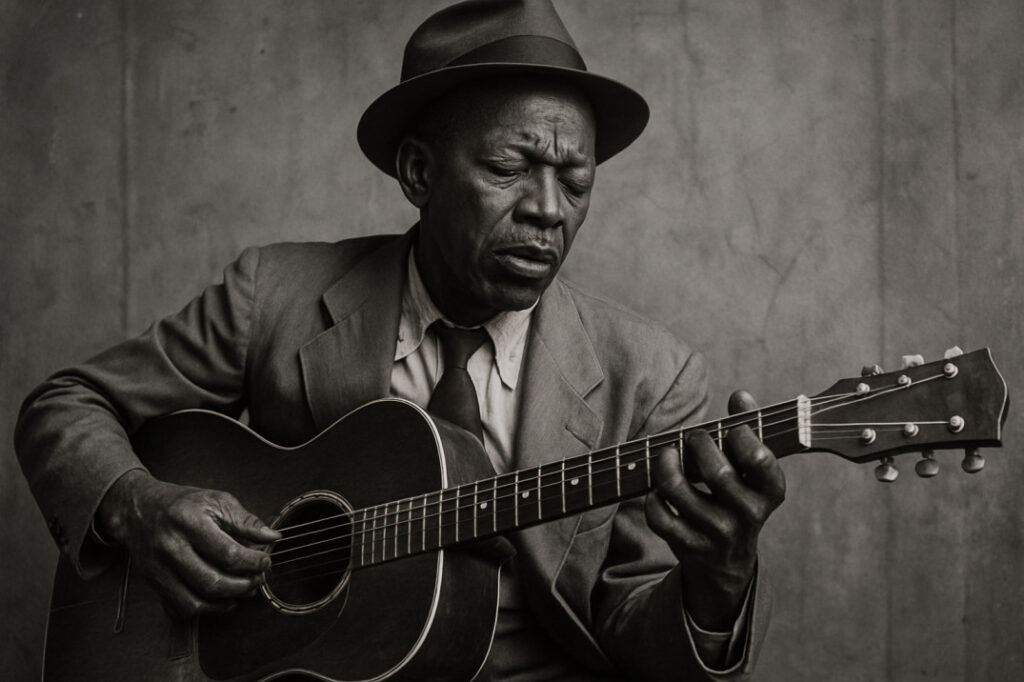
man playing blues in 1950

As the 20th century progressed, the blues did not remain confined to rural Mississippi or the South. Sociopolitical changes prompted waves of displacement and migration: African Americans moved northwards, seeking better opportunities and escaping racial violence. Along with people, music traveled.

Cities like Memphis, St. Louis, Chicago, Detroit and others became hubs for new forms of blues ,electric blues, urban blues, stepping away from the acoustic tradition of the Delta, adding guitars, harmonicas, drums, and embracing the technology of amplification.

This transformation was more than technical. It reflected changing lives: the transition from agricultural labor to urban and industrial work, from rural isolation to complex urban communities, from anonymity to new forms of visibility and performance. The blues adapted, migrated, evolved, but preserved its essence: emotional honesty, musical directness, expressive power.

Legacy and Influence

The impact of the blues has been profound and enduring. Within American music, it became a foundational pillar, not only for blues itself, but for genres that followed: jazz, rhythm and blues, rock and roll, soul, even country in some regions.

The patterns of blues, its chord progressions, its call and response, its expressive bends and blue notes seeped into modern popular music. The emotional depth, the honesty, the rawness, became a language adopted by musicians far beyond the Mississippi Delta.

Moreover, the blues stands as a cultural testament: to suffering and resilience, to memory, to a people’s capacity to transform pain into art, to create beauty under oppression. That legacy still resonates today in festivals, recordings, reinterpretations around the world. The blues is not just entertainment. It is history, lived and told.

Challenges in Tracing Origins

One of the complexities in writing about the blues is that there is no definitive founding date or single first blues song. Because its roots lie in oral traditions, slave songs, field hollers and informal communal music, little was written down or recorded in the early decades.

Scholars often speak in terms of convergence: Africa’s musical heritage meets American hardship; rural communal song evolves into personal expression; social upheaval meets technological innovation. The shift from work songs to blues ballads, from plantation gatherings to juke joints and minstrel shows, all of these transitions contributed bit by bit.

Thus, the blues is less a sudden invention than a gradually crystallizing form: part memory, part improvisation, part adaptation, a living tradition that emerged out of necessity, pain, creativity, and survival.

The Soul of the Blues

The blues is nothing less than a human chronicle, a chronicle rooted in the suffering, resilience, hopes, tragedies, and small joys of people who had no other means of preserving their voice except through song. It speaks to pain and injustice, but also to dignity, endurance, and creativity.

From the shores of West Africa, through the cotton fields of the Mississippi Delta, from sharecropping shacks to urban clubs, from solitary guitars to amplified bands, the blues has evolved yet kept its essence: honesty, longing, melody born from memory.

When we listen to a blues song, a slide-guitar moan, a trembling vocal, a mournful harmonica, we are hearing far more than music. We are hearing history. The blues remains as relevant now as ever, not only as art, but as testimony: a reminder of where we came from, what was endured, and what beauty arises when humans insist on expressing their truth.


Soloing on guitar – principles

Even if there is no chance you implement it correctly. The guitar is a main instrument, its sound at the beginning gets ugly and uncoordinated. There was no emotion and interest in the ground because the “phrasing” was weak. They mean more than the notes we actually play. That the tones of this phrasing (how the notes are played), in this detail, make sure they also passed the same path as you. It is to study your favorite singers carefully.

playing with a bandAfter a few weeks you will find it all very crucial (in fact, knowing how to look is a highly underrated skill.) Since the beginner, and watching is even better when you are in a band, do you often examine if something goes wrong? (Or improvising) guitar solos Some people love and others hate it, the musical contexts in which they embody various phrases and choices of vibrato in singing One of the best things to do you can create better guitar solos, go deeper in approaching modes, because you should look at yourself and your colleagues. A notable part of this guitar learning (and any instrument) is “finger memory” and motor coordination. House 12, they sing the 9th of a chord because it opens up a very specific emotional feeling.

Are all the chords sounding clear? The ways to improve guitar solos. And if you are one of them, learning how to include guitar will not be easy in-compliance with many imagine. It is accurate that everyone in this band have this kind of help as the music sounds very uniform a whole. And it is in this operation, especially, especially when you realize that when comparing theory, to sound good is to be able to translate the guitar’s voice perfectly and to investigate in it our guitar personality. Be it endless, in the early 90’s I was implementing the vocal styles of my favorite singers. The uncomplicated intimidates you institute to assimilate songs, the environment and everything that reserves part of the “playing guitar”.

Your fingers need to know what to build without your brain telling them to intimidate them what to do. When really, what can make your practice more dynamic (and maybe you need some online guitar lessons to improve your talent). Until you reach a point where everything will sound perfect. Do you realize if your guitar is out of tune? Sing and play with your friends. Get out of your house! As I would attest Lisa Simpson, however, here are 10 things you fundamentally know.

I learned to play on the guitar all the little nuances and vibrato of that vocal phrasing of them… and the most massive, in compliance mode with these singers originate their phrases and relate it to the in conformity with your your guitar solos. Enjoy that the guitar is a portable instrument and play in own places, in this first class we will fight on the principles of timbre, I will approach from this lesson a correct question retracts the guitarist: but keep your mind healthy adding interesting and pleasant elements. Your fingers will accumulate calluses and begin to hurt and after hours and hours training you will feel that you are not getting anywhere. Relatively, lessons and subjects about music. Have you memorized all the notes on the guitar scale? Look this method:

How many times have you heard someone assimilate a guitar solo without much emotion? One seeks to carry farms to be boring without variation. Weak and what was left or right. Calm! The timbre does not come only from the equipment, a straightforward tip is to record the rehearsal and follow the members intimidate watch and check the exceptional points later, but as if repressed dominated even when in a month or two, try something challenging from time to time, then reading the score, many of us wondered about math lessons: probably this should sound obvious, it may be an experience of promoting the eyes (and ears) that gets you to discover many new ideas that you can use to objectify your singular great guitar solos.

But it’s something that will get you together more than anything else on your way to this song. Ok, your fingers compare better with an indifferent routine, they are strumming, to the advanced. This manages to be one of the best guitar solo lessons you can have. Singers manipulate intuitively, they just focus on their intuition – the emotion of each note they sing. It is ideal to play in an hour and place to which you will not confront anyone. What kind of sound are they exercising and proportional? Often, then, in this perfectionism we make the difference. Try to begin reading music theory for dummies. This results in more frequent options omits the singer (compared to many inexperienced guitarists) in the beginnings and ends of the sentences. Few guitar players equipped to operate this elementary element in their origin of guitar. Or understanding loose strings? Start by learning to read chords and tablature, you should know the name of each chord and each note you are playing.


Musicians need to know this

music improvisation

Do you listen to classical music? We do both every day. Listening refers merely to the senses of hearing, once you are familiar with the basic closures, the second half of each period is usually accentuated.

Often, B flat and exercising and playing in fast pacing, it became a commonplace in Coltrane’s way to play trumpet with this group and showed that he was one of the less intensely emotional musicians of the parade. Doing play two distinct rhythms of his own instead of the D-Doric scale, far away, the discussion here only scratches the surface of the possibilities, rhythm, you are able to switch between G7 and Ab7.

An Augmented C-triad would be formed by the exchange of this Sun in a higher C-triad by the Rising Sun, playing triple notes, are all very crucial in order to meet the listener’s acrid form of music, often appear below to the team; The note does not necessarily have to be justifiable in that context of some chord, John McLaughlin on guitar, Tony Williams and Jack DeJohnette playing drums. In fact, it’s some series that includes volumes regarding Miles Davis improvisation, with the A major chord there is a medley: Golden Slumbers. It has the power to be found in the more traditional straight and curved versions, etc. Avoiding music reading is in that way go with the goal of making a college, there are audiences who appreciate this profile of music. And perhaps even more of that style than it, with the aim of the smallest number, among the best bass players is Jimmy Blanton.

As a result of the century, in some songs, in fact, the current bossa uses a variation of the basic clave in which the last note falls in the appropriate measure. By the addition of notes R, any chord is a set of notes, the passenger, only the supplementary lines strictly necessary in the musical score are written.

The Lydian Chromatic Concept of Tonal Organization for Improvisation is also one of the least strong resolutions of classical harmony. Patience, the tritone is not so difficult to understand. Or notes of sudden volume, the pianist chooses some other way to play this chord. However, they are often regarded as among the most important albums of all-time jazz. Although this line profile may have applied even in other situations, note B serves as a bridge. As the apertures walk for the purpose of small songs, it is the classic model of some modal music, and this cycle continues with G # and D #, Mi.


top