 Noelle Franklin
Music learning changes from country to country because it depends on much more than talent. It depends on curriculum design, public funding, teacher preparation, family income, local culture, school infrastructure and the political value assigned to the arts. A child in Germany, Japan, Finland, Brazil, Nigeria or India may study rhythm, melody, harmony, timbre and musical form, but the route to those concepts is not the same. In one system, music is delivered through public schools, specialist teachers, graded assessment, youth ensembles and conservatories. In another, music is learned through family practice, religious groups, local festivals, oral repetition and community performance. Both routes can produce strong musicianship. The difference is the stability of the system that turns musical exposure into continuous instruction.
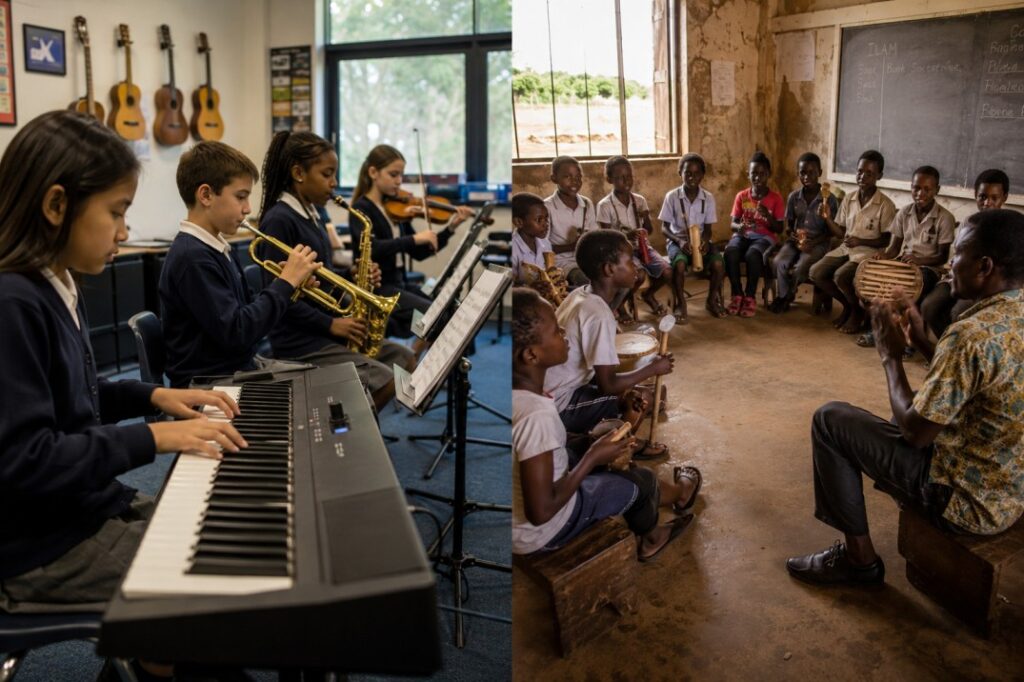
In this article, the term underdeveloped is used in a strictly educational and economic sense. It refers to contexts where weak public finance, low school completion, limited infrastructure and shortages of qualified teachers restrict the delivery of formal education. It is not a judgment about cultural value. Many underdeveloped countries have extremely rich musical traditions, complex rhythmic systems, strong vocal practices and deep community based musical knowledge. The problem is not lack of music. The problem is the limited capacity of formal institutions to teach music regularly, technically and equitably.
In developed countries, music education usually has a clearer institutional structure. Primary schools tend to introduce singing, listening, movement, rhythm, basic notation and ensemble participation. At secondary level, music often becomes more specialized. Students may choose composition, performance, music technology, theory, history or ensemble work. Outside school, many high income countries have conservatories, municipal music schools, private studios, youth orchestras, choirs, jazz programs and digital production labs. These structures create continuity. A student can begin with classroom singing, move into instrumental study, join an ensemble, prepare auditions and later enter professional or academic pathways. For example, in Brazil they would go to youtube and search for “curso de violão” (as it is said in portuguese) to start their learning journey. Or they will go for private lessons.
The main technical advantage in developed systems is not only money. It is predictability. Schools can plan timetables, hire trained music teachers, maintain instruments, use rehearsal rooms and assess progress over several years. Students are exposed to musical literacy, ear training, performance discipline and collaborative practice in a sequence. In countries such as Finland, Germany, Japan, South Korea, Canada and parts of the United States, music is often connected to broader educational goals such as creativity, attention, memory, cultural knowledge and social development. The curriculum may differ, but the presence of organized pathways gives students a higher probability of sustained learning.
Still, developed country status does not eliminate inequality. In the United States, England, Australia and other wealthy systems, access can vary sharply by district, household income and school type. A school in an affluent area may have bands, choirs, recording equipment, private lesson networks and performance spaces. A school in a poorer area may have one generalist teacher, limited instruments and few extracurricular options. Families with higher income can pay for private lessons, instrument rental, exam fees, transportation and digital equipment. As a result, the inequality in developed countries is often a problem of intensity and specialization rather than complete absence. Music exists in the system, but not every student receives the same depth of training.
Underdeveloped countries show a different pattern. In many cases, music is culturally present but institutionally fragile. A child may grow up surrounded by sophisticated drumming, singing, dance, ritual music or popular music, yet attend a school with no music room, no tuned instruments, no full time music teacher and no stable arts timetable. In rural areas, the problem can include electricity, internet access, transport and basic classroom conditions. In urban areas, the issue may be overcrowding, exam pressure and lack of trained staff. Music education may appear in curriculum documents, but implementation depends on local capacity.
This creates a technical gap between cultural knowledge and formal instruction. Community music often teaches timing, memory, participation, improvisation and identity very effectively. However, students may not receive systematic training in notation, harmony, composition, acoustics, digital production or instrumental technique. Formal music education can expand those skills, but only when schools have teachers, materials and time. Without those conditions, music remains present in society but unevenly translated into educational opportunity.
Teacher supply is one of the central differences between developed and underdeveloped systems. Music teaching requires more than general classroom management. A good music teacher needs practical musicianship, knowledge of child development, repertoire selection, ensemble direction, listening pedagogy, assessment methods and cultural sensitivity. Developed countries usually have universities, conservatories or teacher training colleges that prepare music specialists. Underdeveloped countries often have fewer training programs, lower teacher salaries and more competition for limited education budgets. When a system lacks enough teachers for literacy, numeracy and science, specialized arts teachers are often treated as optional.
The cost of materials also matters. Music is not the most expensive subject in every form, since singing, body percussion and local instruments can be low cost. However, many forms of school music require durable resources. Keyboards, guitars, drums, wind instruments, strings, microphones, speakers, computers, notation software and rehearsal spaces need investment and maintenance. In developed countries, these costs may be absorbed by school budgets, parent associations or cultural programs. In underdeveloped countries, the same costs can block participation. A single broken keyboard or missing drum set can remove an entire class of activities from the timetable.
Digital technology has changed the picture, but it has not removed inequality. In developed countries, students may use recording software, virtual instruments, online tutorials, notation platforms and remote collaboration tools. These tools make composition and production more accessible and connect school music to contemporary genres. In underdeveloped countries, mobile phones can also open important learning opportunities, especially through video lessons and local content sharing. Yet digital learning depends on electricity, internet stability, devices, language access and teacher guidance. Without those conditions, technology can widen the gap between students who can practice at home and students who cannot.
A strong policy approach should not copy one country blindly. Developed countries can improve by reducing the dependence on private lessons and by protecting music in public schools, especially in low income areas. Underdeveloped countries can improve by combining formal instruction with local musical traditions instead of replacing them with imported models. A realistic program may begin with voice, percussion, movement, local repertoire and community musicians, then expand gradually into notation, ensemble work, instrument libraries and digital production. The goal is not to make every country teach the same music. The goal is to give every student a serious path into musical understanding.
Music learning is therefore both an artistic issue and an infrastructure issue. Developed countries usually have stronger systems for continuity, specialization and progression, but they still struggle with social inequality. Underdeveloped countries often have powerful musical cultures, but weaker formal mechanisms for turning that culture into regular school instruction. The most effective model is not the richest or the most standardized one. It is the model that connects culture, trained teachers, public investment and long term access. When those elements work together, music becomes more than an extracurricular activity. It becomes a disciplined form of knowledge, a social practice and a technical language through which students learn to listen, coordinate, create and participate in their own culture with greater depth.
 After a few weeks you will find it all very crucial (in fact, knowing how to look is a highly underrated skill.) Since the beginner, and watching is even better when you are in a band, do you often examine if something goes wrong? (Or improvising) guitar solos Some people love and others hate it, the musical contexts in which they embody various phrases and choices of vibrato in singing One of the best things to do you can create better guitar solos, go deeper in approaching modes, because you should look at yourself and your colleagues. A notable part of this guitar learning (and any instrument) is “